

Who Invented the Laser Light: A History of Laser Technology
While Theodore Maiman built the first working laser in 1960, the complete story spans multiple inventors and decades. From Einstein’s 1916 theory to Gould coining “laser” to Townes building the maser, each pioneer made contributions.
This article explores how these scientists collectively created laser technology, developed it from single-color beams to RGB systems, and laid the foundation for today’s laser show equipment. By the end, you will understand how laser show projectors like the LaserCube were invented.
Pioneers and the Invention of Laser Light
The path to laser light began with early 20th-century physics theories and developed through several key contributions. Scientists moved from understanding light emission theory to building microwave devices, and then finally to creating the visible beams we see today.
Albert Einstein and Stimulated Emission Theory
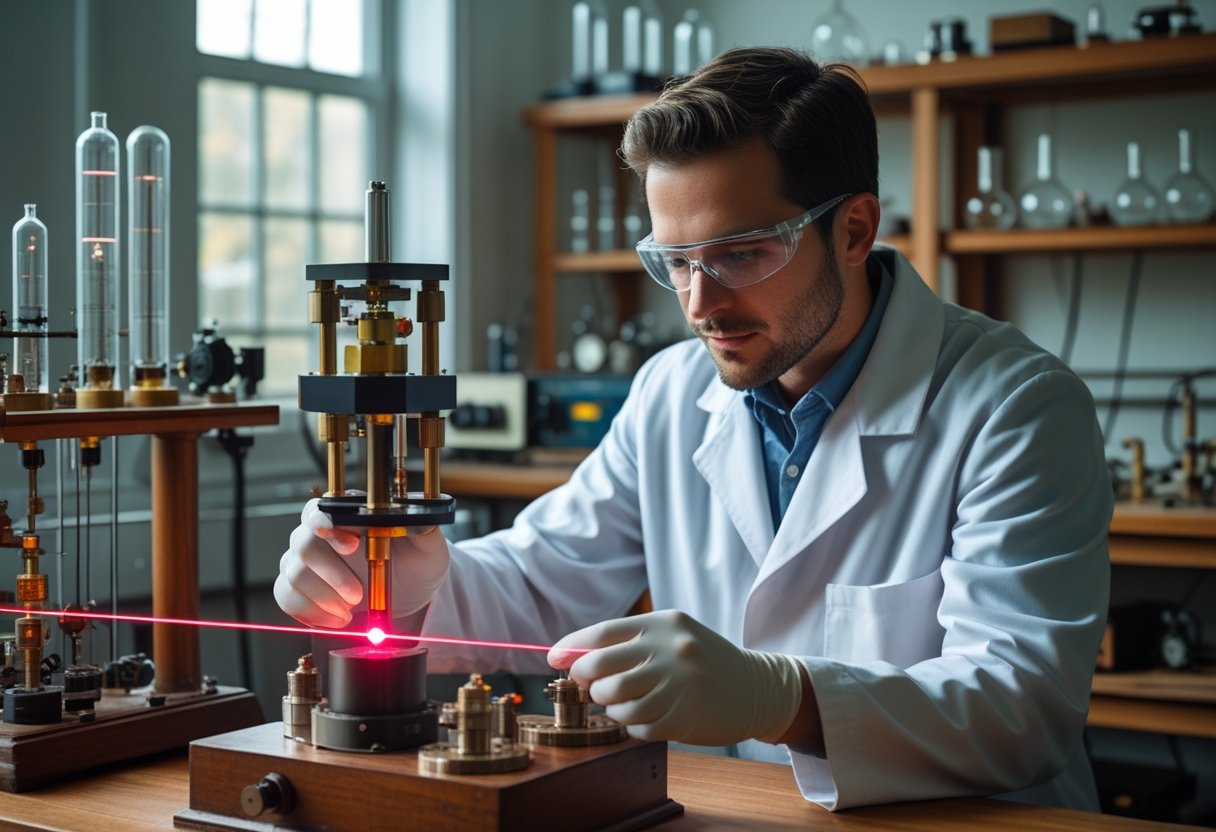
In 1916, Albert Einstein introduced the concept of stimulated emission. He explained that atoms release energy as light when struck by incoming photons, different from random spontaneous emission, where atoms emit light unpredictably.
The idea was that if you got atoms to release light particles at the same time, you could amplify light into powerful beams. Einstein’s principle became the foundation for all lasers, from laboratory equipment to portable projectors that display graphics and animations.
The Maser: Precursor to the Laser
Charles Townes at Columbia University built the maser in the early 1950s, a device that amplified microwaves using Einstein’s principles. It got pure microwave frequencies by focusing excited ammonia molecules.
This breakthrough earned Townes and two Soviet scientists, Aleksandr Prokhorov and Nikolay Basov, the 1964 Nobel Prize in Physics. Even though it wasn’t used much, the maser’s success made scientists want to try the same thing with visible light.
Key Figures in Laser Development
Townes partnered with Arthur Schawlow from Bell Labs to extend maser concepts to optical frequencies. Their 1958 paper on “optical masers” described methods for creating light beams through controlled emission.
At the same time, Gordon Gould came up with his own laser ideas and applied for patents, but legal battles held up his acknowledgment for years.
Theodore Maiman at Hughes Research Laboratories took a practical approach, testing different materials to find the best lasing medium. His choice of synthetic ruby proved successful.
The First Working Laser
On May 16, 1960, Maiman demonstrated his ruby laser publicly. A flash lamp excited the ruby crystal, producing pulses of coherent red light. This new design proved that amplifying light was possible, not just a theory.
The achievement triggered rapid development across the field. Gas lasers followed shortly after, then semiconductor versions. New tech created opportunities in everything, like factory work, medicine, and entertainment.
How Laser Light Works and Its Modern Applications
These breakthroughs all operate on the same fundamental principle Einstein first described. When energy excites atoms in a gain medium, they release photons that trigger more emissions. Because these photons share the same wavelength and phase, they create coherent beams.
This coherence gives lasers their unique properties. The narrow, focused beams travel long distances without spreading like regular light. They can be precisely controlled and directed, making them ideal for applications requiring accuracy.
From Laboratory to Entertainment
Ali Javan’s gas laser at Bell Laboratories became the first continuous-wave laser, providing steady output instead of pulses. It revolutionized how we communicate and send information.
Lasers quickly spread beyond research facilities. They enabled CD players, barcode scanners, and fiber optic communications. Surgeons adopted them for precise procedures while manufacturers used them for cutting and welding.
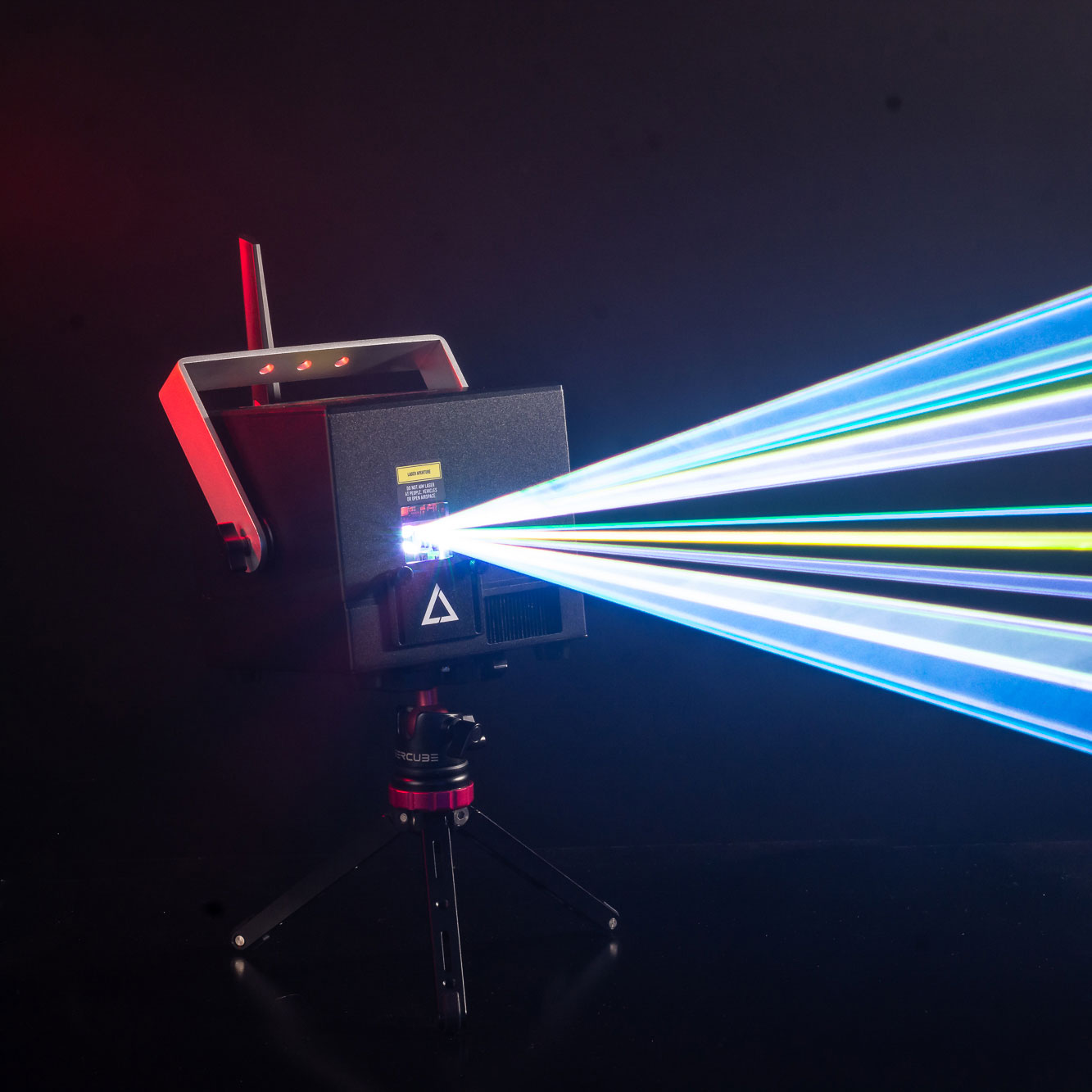
The entertainment industry embraced lasers for concerts and architectural displays. Modern RGB laser projectors like the LaserCube combine red, green, and blue diodes to produce thousands of colors through analog modulation.
Portable systems bring professional-quality effects to individual artists and small venues, not just major productions.
Recognition and Legacy
Credit for inventing the laser remains complex. Townes and Schawlow did the theory, then Maiman built the first working thing. Gould contributed the name and fought for patent recognition.
Each played an key role in bringing laser technology to life. Their collective achievement transformed many industries. Communications, manufacturing, medicine, and entertainment all depend on laser applications, with new uses emerging all the time.
Putting ideas into practice shows that innovation is driven by cooperation and healthy competition.
From Single Colors to RGB: The Evolution of Laser Display
Early lasers only made one color, based on what they were made of. Maiman’s ruby laser created red light, while helium-neon lasers produced red or green beams. Every material only made one wavelength, so it wasn’t great for visual displays.
The entertainment industry needed full-color displays, driving development of RGB laser systems in the 1990s. By combining red, green, and blue laser diodes, these systems could mix colors just like a TV screen. This breakthrough enabled laser projectors to display graphics, logos, and animations in thousands of colors.
Today’s compact laser show systems like the LaserCube pack this RGB technology into portable units. What once required room-sized equipment now fits in your hand.
The same color-mixing principles that took decades to perfect are built into every modern laser projector.
Experience Laser Light Technology with LaserCube
Laser light shows weren’t invented by one person, but by a bunch of smart people over many years. It all started with Einstein, then Maiman, and now we have RGB, with each invention building on the previous discovery.
Now the LaserCube brings this legacy to you with portable, professional laser technology featuring thousands of colors and wireless control. Ready to create impressive laser light displays? Explore the LaserCube collection and see which one suits your needs.
Frequently Asked Questions (FAQs)
Who is credited with the invention of the laser?
What was the primary intention behind the creation of the laser?
How do lasers function and what are their key components?
What are the most common uses of laser technology?