How Do Lasers Work? A Simple Guide to Visible Beam Lasers
Wondering how do lasers work? Discover the science behind concentrated light and how visible beam lasers create massive 3D aerial effects for live events.

Have you ever noticed the difference between a flashlight and a laser pointer? A flashlight spreads its light out into a wide, dim cone that fades quickly. A laser pointer creates a tight, bright dot that stays visible across a large room. Lasers use highly concentrated light, and understanding how they work is the first step to running a professional, visible beam show.
Why Laser Light Cuts Through the Dark
Regular light bulbs scatter energy in all directions. Laser light travels in a single, tight line.
Think of a standard lightbulb like a crowd of people walking in random directions, causing the light waves to bump into each other and spread out. A laser acts more like a marching band where all the light waves move perfectly in step side-by-side. This tight organization keeps the light focused and bright over long distances.
How Projectors Draw Shapes in the Air
A basic laser produces just a single dot of light, meaning a projector needs mechanical help to move that beam around the room. Modern projectors use fast-moving internal mirrors to steer the light rapidly and draw pictures.
These internal mirrors are called galvo scanners, and they move so quickly that they trick the human eye. Instead of a single point of light, the eye sees a solid shape, text, or animation. The faster these mirrors move, the more complex the graphics they can draw, causing no visible flickering.
The Physics of Visibility: Why the Laser Beam Hides
Laser light is completely invisible in clear air, only becoming apparent when it strikes a solid surface like a wall or a screen. Users often turn on a new projector and feel confused when they only see a dot across the room.
An aerial beam remains hidden because there are no physical particles in the air for the light to reflect against. Light only registers to the human eye when it bounces off an object first.
The Missing Ingredient for Visible Beams
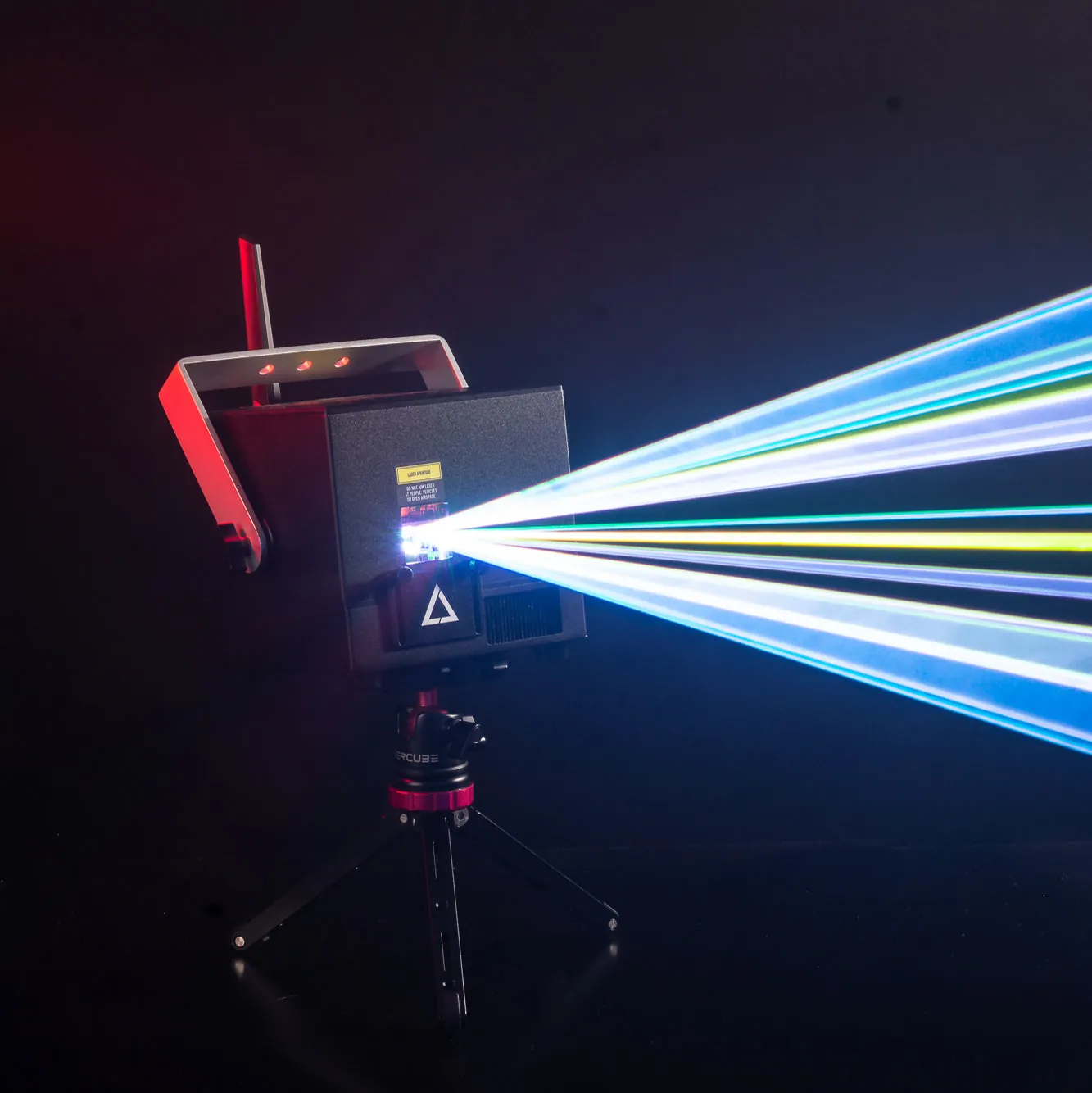
To see actual laser beams cutting through the air, the light must strike small atmospheric particles. Adding fog or haze to a venue gives the concentrated light something to bounce off.
When the laser beam hits these floating particles, they scatter the light back toward the viewer. This simple atmospheric effect transforms a flat 2D wall projection into a massive 3D volumetric experience.
A tool like the Nano Fogger provides this exact type of atmosphere. It is a compact fog machine designed specifically to make beams visible without choking the entire room with thick smoke.
Portable Options for Laser Setups
Running a visible beam show no longer requires heavy touring equipment or managing long power cables. Compact, battery-powered projectors allow for fast setups in any location without ever searching for wall outlets.
The LaserCube WiFi Series offers a completely wireless, plug-and-play solution for this exact scenario. Available in 1.2W and 2.5W versions, these devices pack professional diode technology into a portable chassis that boasts two to three hours of battery life. Operators can connect them directly over WiFi, or use an Ethernet cable for a hard-wired setup.
Users manage the entire performance through the free LaserOS app. This software connects directly from a phone or laptop and includes hundreds of pre-built animations, removing the need for complex programming.
Wrapping Up
Lasers organize light waves to deliver intense brightness, but they still rely on a hazy atmosphere and fast hardware to create a complete visual experience.
Anyone ready to build a wireless visible beam setup can visit the LaserCube product page to explore the 1.2W and 2.5W WiFi models and start projecting high-quality effects tonight.
Frequently Asked Questions (FAQs)
Q01Why does a laser graphic flicker on the wall?
Flickering happens when the internal galvo scanners move too slowly to draw a complex shape. To fix this, users need a projector with a higher scanning speed (measured in points per second, or pps) or they need to project a simpler graphic.
Q02Is a massive smoke machine needed to see laser beams?
No, a very light haze performs better than thick smoke. A small hazer or the Nano Fogger provides an even mist that reveals the beams perfectly.
Q03Are high-power lasers safe to use indoors?
LaserCube is a professional show laser, not a toy: never aim it at people's eyes, at audiences or at aircraft, and never at anything flammable. Indoors, keep every beam at least 3 m (10 ft) above the floor wherever people may be, and never let it scan into the audience. Safety zones in the software help keep beams off cameras and objects, but they never protect people. More safety tips.
See it for yourself
LaserCube is a portable, battery-powered RGB laser projector, and its show software, LaserOS, is free.
Explore the LaserCube lineup