Visible Beam Laser: Why Beams Go Invisible
Visible beam laser not showing up? Learn why beams need fog to become visible in the air, and how to fix it.
Why your laser beam isn't visible (and how to fix it)
You set up a new laser projector, expecting bright beams cutting through the air like the clips online. You switch it on, and all you get is a shape on the wall. It can feel like the unit is broken or underpowered. The good news is that the laser is likely fine.
The reason those beams don’t show up in the air has little to do with the projector and everything to do with what’s floating in the room.
Here is why laser beams go invisible, and the simple fix that brings them back.
A laser beam is invisible until something scatters the light
A laser beam only becomes visible when its light bounces off something and travels back to your eye. Clear air is mostly empty space, so there is almost nothing in it for the light to hit.
That is why a laser beam can shoot across a room and stay invisible. The light is there, but it moves in a straight line without scattering toward you.
Those glowing beam shows online look the way they do for one reason. The room is full of haze, and every tiny particle in the air catches a little of the light.
Surface effects and aerial beam effects are two different things
Laser projectors create two different looks, and mixing them up is the top reason people think their laser isn’t working.
The first is surface projection. The beam lands on a wall, floor, ceiling, or screen and shows up as a bright pattern, text, or logo. This works every time, with or without haze.
The second is the aerial beam effect. The beam travels through open air until it ends on a wall, the ceiling or another surface. This one needs particles in the air to be seen.
Picture a wedding. A monogram projected onto a wall looks sharp with no haze at all. Now picture a club night, with beams sweeping overhead, at least 3 m (10 ft) above everyone on the dance floor. That look only appears once there is haze in the room.
So if a laser shows patterns on the wall but no beams in the air, it usually is not broken. It just needs something in the air for the light to catch.
Fog is what turns an invisible beam into a visible one
Haze fills the air with tiny particles that scatter light back toward your eye. That scattering is the whole trick behind every aerial beam show.
A fog machine pushes out a fine, even mist that hangs in the air. The beam passes through it, lights up each particle, and the full line of the beam becomes visible.
A little fog goes a long way. Too much can set off a venue’s smoke detectors, so it is worth testing first and checking with venue staff, following ESTA’s guidance on atmospheric fog and haze effects.
A light, even layer is usually all it takes. For a closer look at how much haze a show really needs, see our guide on whether you need fog for a laser show.
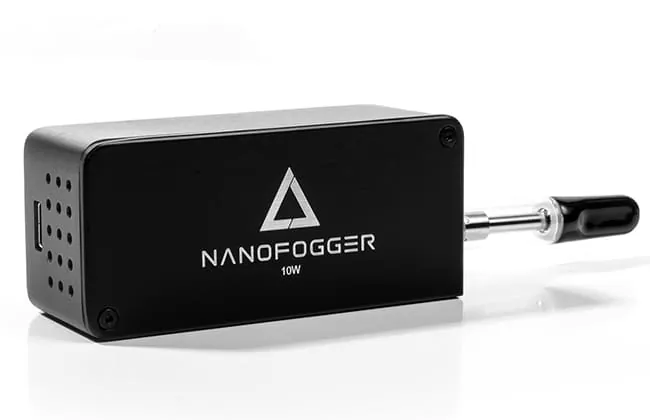
The Nano Fogger is a handheld 10W fog machine built to pair with LaserCube. It is made for revealing beams during testing or short, temporary use, not for running all night in a club. That makes it a simple way for a DJ or home user to see what their laser can really do before deciding on a bigger haze setup.
Room darkness and laser power also shape how strong the beam looks
Haze is the biggest factor, but a dark room and enough laser power both change how strong a beam looks.
Ambient light washes out beams fast. A dim bar and a pitch-black warehouse will make the same laser look very different.
Power and distance matter too. Beams get wider and fainter the farther they travel, so a bigger space needs more output to keep them looking clean.
Beam color plays a part as well. Green reads brighter to the human eye than red or blue at the same power, which is part of why full-color RGB lasers have so much visual impact.
For larger rooms and festival stages, a higher-output unit like the LaserCube 10W Ultra MK2 (10,000mW) holds up better than a smaller model in the same space, and travels farther before the beam fades. By comparison, the LaserCube 2.5W WiFi runs at 2,500 mW and the 1.2W WiFi at 1,200 mW, which is plenty for a home setup or a small DJ booth but not built to compete with a huge, bright venue.
A laser that looks strong in a living room can look weak on a big stage until the power and haze are matched to the room. For more on what separates the two tiers, see our guide on pro laser systems vs. consumer lasers.
No fog does not rule out a great laser show
No haze does not mean no laser show. It just means the show leans on surfaces instead of open air.
Plenty of venues do not allow fog, or a host simply does not want haze drifting through the room. That is completely workable. Aiming the laser at walls, ceilings, screens, or a backdrop still gives you text, graphics, and animation.
LaserOS, the free software included with every LaserCube, gives you full control over what the projector shows and where it lands.
The LaserCube WiFi series fits this use case well, since it’s built for mobile DJs and home users who mostly want clean graphics and text rather than aerial beams. A no-haze setup is not a downgrade. Some of the sharpest laser looks are surface-only.
Wrapping Up
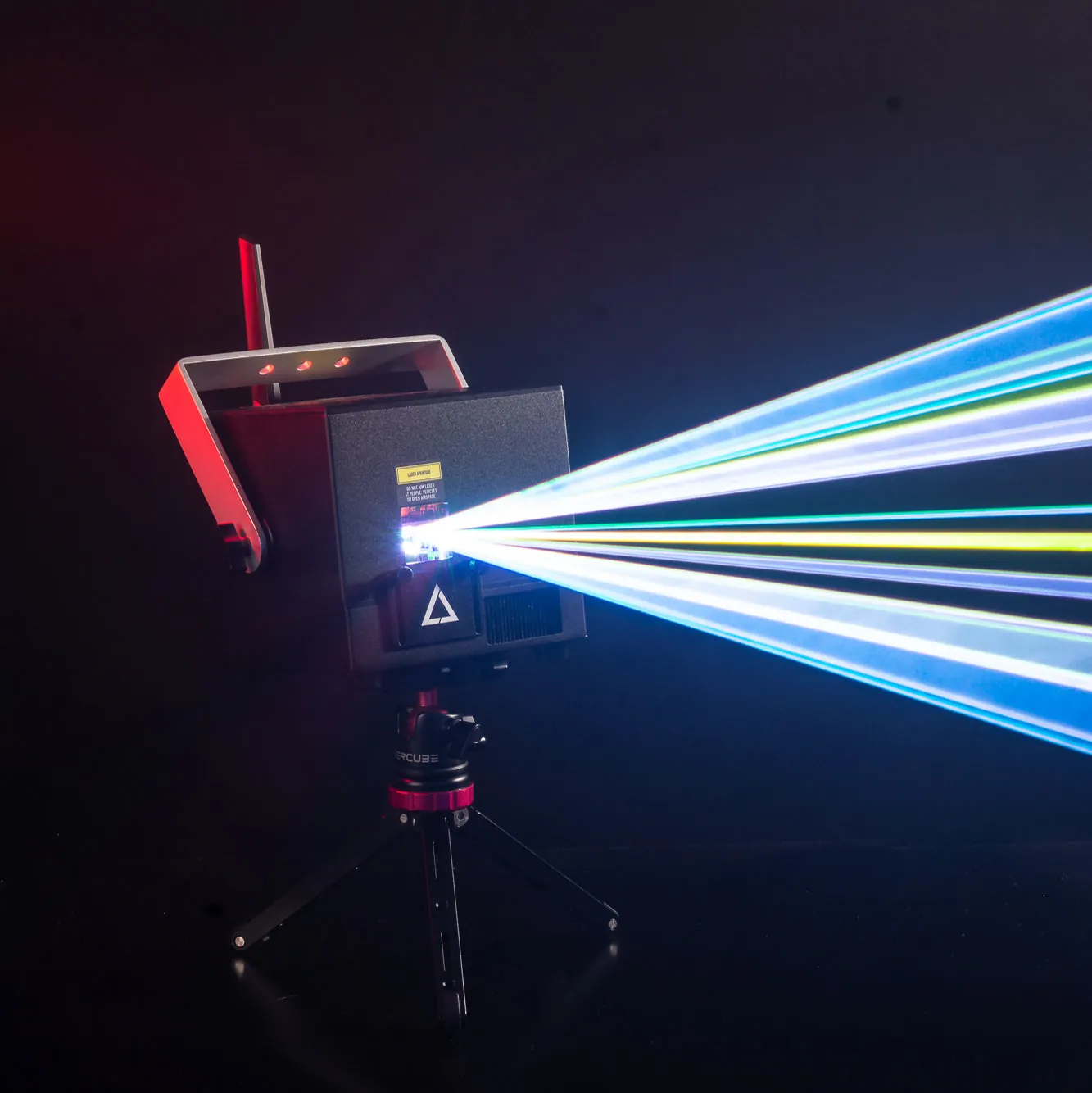
Laser beam visibility comes down to one thing: particles in the air for the light to catch. Fog is the fastest way to get there, and the Nano Fogger is made to pair with LaserCube for that full aerial beam look without the bulk of a large fog rig.
Want to see the full LaserCube lineup? Visit the product page to compare models, bundles, and accessories, and find the right setup for the next show.
Frequently Asked Questions (FAQs)
Q01Why can't I see my laser beam in the air?
The air in the room is usually too clear for the light to scatter. Add a light layer of haze or fog, and the beam becomes visible as it passes through the particles.
Q02Do you need fog for a laser show?
Only if you want aerial beam effects. Surface projection, like text, logos, and graphics, shows up clearly without any haze at all.
Q03Does beam color change how visible a laser is?
Yes. Green looks brighter to the human eye than red or blue at the same power, though a full-color RGB setup gives you the most flexibility.
Q04Is a little haze enough, or do you need a lot?
A light, even layer is usually all you need. Too much fog can hide the effect, make the room uncomfortable, and set off smoke detectors.
See it for yourself
LaserCube is a portable, battery-powered RGB laser projector, and its show software, LaserOS, is free.
Explore the LaserCube lineup