

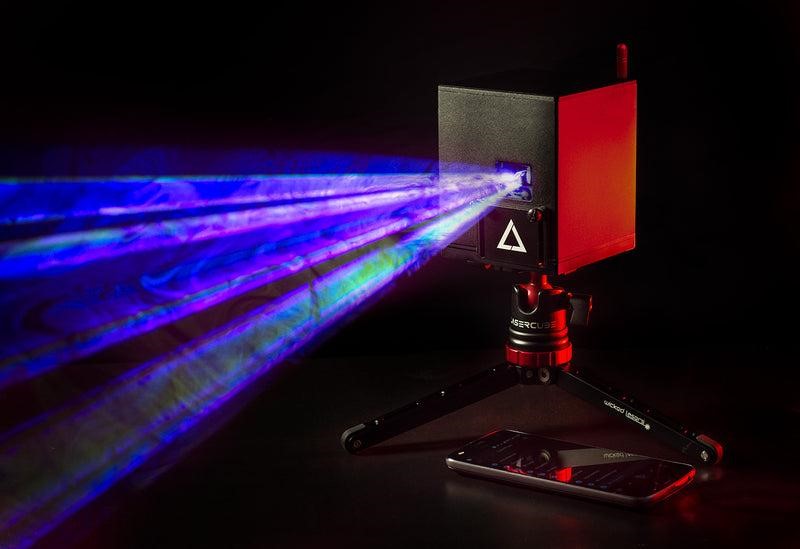
What Is a Laser Light? Technology, Uses, and Why Vector Light Outperforms Standard LEDs
Event producers and performers often rely on standard LED fixtures or traditional video projectors for event visuals. However, conventional wash lights scatter energy quickly, and video projectors struggle with dark contrast levels in ambient light.
Laser light solves these venue challenges through unique physical properties. By using coherent, single-wavelength light beams, compact laser systems deliver sharp vector graphics and dense aerial shows that cut through bright environments.
Understanding Laser Lights
These lights create very focused and intense beams, working because of specific scientific principles and special parts inside that control the light. Let’s look at what makes them different.
Understand coherent light vs. incoherent light (and why beam density stays sharp)
A laser light is a concentrated beam produced through stimulated emission, generating synchronized light waves that maintain high energy density over long distances. The word laser stands for Light Amplification by Stimulated Emission of Radiation. Inside a modern laser projector, semiconductor diodes excite atoms to release identical photons in a single direction. To learn more about photon behavior, readers can explore our guide on what a laser beam is.
Standard light sources produce incoherent light. A light bulb or LED fixture emits chaotic, multi-directional light waves that spread out and lose intensity within a few meters.
In contrast, laser diodes produce coherent light. Every light wave moves in exact alignment and phase. Because the photon waves do not scatter, a laser beam maintains tight divergence, staying focused and visible across 100 meters or more.
Steer diode beams with high-speed galvo scanners to draw vector graphics
Laser show projectors turn point beams into complex shapes, text, and 3D aerial shows by using motorized galvanometer mirrors (galvos) to steer diode beams across the X and Y axes. One internal mirror controls horizontal movement, while a second mirror handles vertical placement.
These tiny mirrors tilt tens of thousands of times per second. This rapid scanning motion tricks the human eye into seeing a solid, continuous vector graphic instead of a moving point of light.
Scanner performance is measured in points per second (pps). Understanding these galvo scanner specs helps performers select the right hardware for their specific production demands:
- 25,000 pps (AT-25S galvos): Found in entry models like the LaserCube WiFi series, ideal for smooth liquid sky sheets, fans, and aerial beam shows.
- 35,000 pps (AT-40S galvos): Found in professional hardware like the LaserCube Ultra MK2, built to render complex SVG logos, custom text, and animations without visual flicker.
Unlike video projectors that paint grids of rectangular pixels, lasers project pure vector geometry. This mechanism offers infinite contrast because the laser diode turns completely off when moving between lines, preventing dark-level light bleed.
Compare laser diodes, standard LEDs, and conventional video projectors
Coherent laser diodes deliver higher energy density, vivid color modulation, and long-range visibility that standard LEDs and video projectors cannot replicate. Comparing pro laser systems vs consumer lighting reveals clear structural advantages for live events.
Standard LED fixtures provide soft wash lighting, but they cannot project sharp lines or long-range beams. Video projectors can display complex video files, but they require heavy AC power cords, large mounting enclosures, and dark rooms to avoid washed-out black levels.
RGB laser diodes use full analog color modulation to mix red, green, and blue wavelengths. This system controls voltage linearly to create 16.7 million distinct color shades with smooth fading transitions.
Hardware efficiency also sets laser systems apart. A battery-powered LaserCube WiFi unit weighs just 3.7 pounds and runs for two to three hours on a single charge. This wireless setup replaces heavy lighting rigs and messy extension cables.
Deploy laser light across mobile DJ sets, club venues, and live productions
Laser light adapts effortlessly to diverse event environments, handling everything from high-energy dance floors to elegant corporate branding. Performers can switch between custom graphics and atmospheric beam shows in seconds.
Mobile DJs use digital projection to display custom wedding monograms and SVG logos. Typing text into control software eliminates the need to order single-use glass gobos or run power cords across a ballroom floor.
Venue operators create 3D liquid sky tunnels overhead by adding atmospheric haze. According to guidelines from the International Laser Display Association (ILDA), airborne particles scatter laser light mid-air to make 3D beam structures visible. Adding an atmospheric accessory like the Nano Fogger provides the mist required for these aerial displays. Performers can read our guide on whether fog is required for a laser show to learn more.
Professional touring rigs integrate flagship hardware into larger stage consoles using DMX laser control protocols, Art-Net, or ILDA network connections. Operators can also explore laser mapping techniques to trace physical architecture and stage props.
Operators protect audiences and camera sensors using digital safety attenuation zones. Configured inside the LaserOS software, drawing blackout boxes instructs the laser to cut power instantly whenever the beam crosses sensitive areas. In the United States, commercial operators also maintain compliance through FDA laser regulations.
Wrapping up
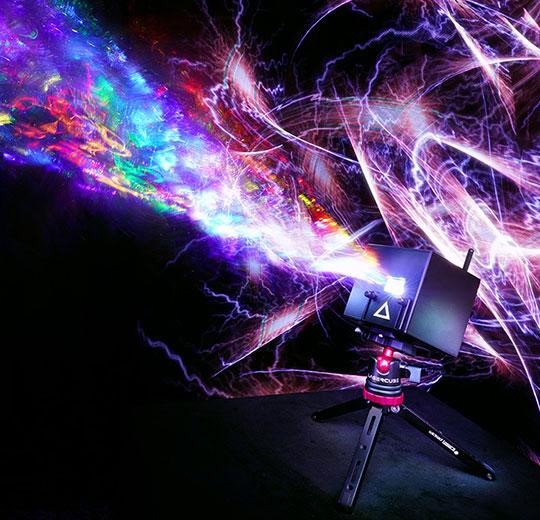
Laser light is defined by coherent beam density, monochromatic purity, and high-speed vector scanning. These unique physical properties make lasers an irreplaceable visual medium for modern live events and creative installations.
Ready to see the full LaserCube lineup? Visit the LaserCube product page to compare models, bundles, and accessories, and find the right setup for your next show.
Frequently Asked Questions (FAQs)
Here are some common questions about these beautiful lights:
How are laser lights built?
What is the main application of lasers?
What does LASER stand for?
LASER is an acronym for Light Amplification by Stimulated Emission of Radiation, describing the key process of how lasers create intense light.
What’s the difference between laser light and LED light?
Laser light is coherent (waves aligned), directional (narrow beam), and usually one color, while LED light is incoherent (waves messy), spreads out, and can be various colors or white. Lasers are focused; LEDs provide general illumination.
Is it legal to use laser lights in public?
Laws vary, but generally, there are rules about power levels and where beams can be pointed (especially avoiding aircraft) to protect eyes and prevent distractions. Always check local regulations and use lasers responsibly. Products like LaserCube are designed with consumer safety standards in mind.